Home » Radiometers

Equipment for the radiographic inspection of scrap metal and waste

Radiometers

We supply radiometers for the radiological screening of scrap metal, waste and cargo. These devices enable the rapid detection of sources of ionising radiation before the material reaches the yard, the warehouse or enters the supply chain.
We work in metal recycling on a day-to-day basis, so we know how important it is to check incoming supplies. We help you choose the right equipment for the scale of your business – from hand-held measuring devices for purchasing to checking incoming deliveries.

Radiometers and dosimeters in the RMC Polska range

Equipment

We offer professional radiometers and dosimeters – ECOTEST radiometers – tried-and-tested equipment for detecting, locating and identifying sources of ionising radiation. They are suitable for radiological screening of scrap metal at collection points, waste reception facilities, steelworks and foundries, as well as for use by radiation protection services, laboratories and medical facilities.

We help you choose the right model for the type of inspection, deliver the equipment and show you how to carry out measurements on a day-to-day basis.

Exploration dosimeter-radiometer

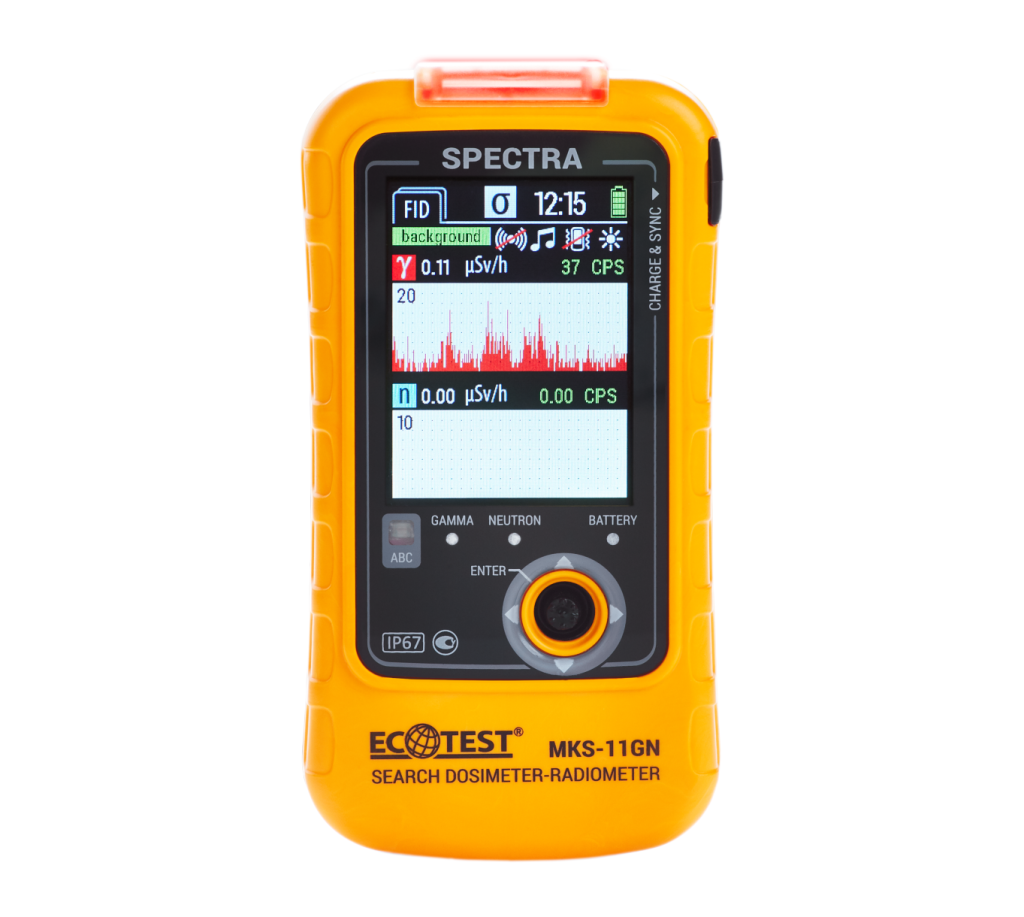
MKS-11GN SPECTRA

A highly sensitive, compact survey dosimeter-radiometer (SPRD) for the detection, localisation and identification of radioactive and nuclear materials based on their gamma and neutron radiation, as well as their gamma spectrum. The device automatically identifies the radionuclide and indicates its category in accordance with IAEA requirements.

Key features

  • CsI(Tl) scintillation detectors – for gamma rays, and LiI(Eu) scintillation detectors – for neutrons, with a silicon photomultiplier, and a Geiger-Müller counter for high dose rates,
  • identification of 26 radionuclides: medical, industrial, natural and nuclear materials,
  • 2048-channel gamma spectrum analyser, capable of storing 250 complete spectra,
  • a built-in GPS receiver and software for analysing and mapping measurements,
  • IP67 dust- and water-resistant casing, weight up to 0.28 kg,
  • compliance with ANSI standards N42.48, N42.32 and N42.33.
Dose rate range (gamma)
0.01 µSv/h – 1 Sv/h
Dose rate range (neutrons)
0.01 – 10,000 µSv/h
The energy range of photons
0.02 – 3 MeV
Sensitivity (¹³⁷Cs)
400 counts per second per µSv per hour
Working hours
over 200 hours (without GPS), USB charging
Dimensions
67 × 127 × 30 mm

Application: radiographic inspection of scrap metal and cargo, detection of radioactive sources in transport, border security, emergency services, and facilities and institutions working with radioactive sources.
Alpha, beta and gamma exploration radiometer

STORA-ABG RKS-01

A compact radiometer-dosimeter with telescopic boom for the rapid detection and localisation of sources of alpha, beta, gamma and X-ray radiation. It measures dose rate and surface contamination, enabling it to check a load, a container or an individual piece of scrap metal without having to approach it.

Key features

  • a Geiger-Müller counter with a mica window, sensitive to alpha, beta and gamma radiation,
  • measurement of gamma/X-ray dose rate, flux density and surface activity for alpha and beta radiation,
  • automatic subtraction of gamma background during beta measurements, and of both gamma and beta backgrounds during alpha measurements,
  • 43–143 cm telescopic boom, with an analogue indicator to help locate the source,
  • a memory capacity of 1,000 results and wireless data transfer to a computer,
  • programmable alarm thresholds, up to 2,000 hours’ operation on two AAA batteries.
Dose rate range (gamma/X)
0.1 – 100,000 µSv/h
Gamma-ray energy range
0.012 – 3 MeV
Surface beta activity
0.22 – 9,999 Bq/cm²
Alpha surface activity
0.2 – 9,999 Bq/cm²
Operating temperature
from −20 to +50°C
Dimensions, weight
160 × 75 × 37 mm, up to 0.4 kg

Application: inspection of scrap metal and waste on site, surface contamination measurements, radiation protection in industry, medicine and laboratories.
The models shown do not represent our full range. If you need a different radiometer or have other requirements, ask us – we’ll find the right device for your business.
Why is monitoring important?

Safety

Radioactively contaminated scrap metal poses a real threat to workers and carries the risk of a delivery being held up at the recipient’s premises. Steelworks and foundries check the material they receive – it is better to detect any problems early on, on their own premises.

The radiometer allows you to

  • check the scrap and waste being accepted,
  • detect sources of radiation in the cargo,
  • to protect staff and the surrounding area,
  • to avoid the consignee rejecting the delivery,
  • document the inspection of the material.

Which radiometer should I choose?

Selection of equipment

STORA-ABG RKS-01

When you need daily inspection of incoming scrap and waste and measuring surface contamination. The boom allows the load to be checked from a safe distance, whilst measuring alpha, beta and gamma radiation provides a complete picture of the hazard.

MKS-11GN SPECTRA

When it is necessary not only to detect radiation, but also determine which isotope it is – whether from a medical, industrial or natural background source. Neutron detection and radionuclide identification are effective for monitoring shipments and large quantities of material.

Not sure which model would be best? Tell us what you’re analysing and on what scale – we’ll advise you and put together a quote. For analysing the chemical composition of scrap metal, we also offer XRF spectrometers.

What you get

Why is it worth it?

Selecting a device

Equipment tailored to the type and scale of the inspection.

Quick measurement

Results in a matter of seconds, right there on the spot.

Expert support

Assistance with the implementation and interpretation of measurements.

Industry experience

We know what day-to-day checks are like at the purchasing centre.

What is the purchasing process like?

4 simple steps

1.

Consultation

We’ll find out what type of material it is and how you’d like to control it.
2.

Selection of equipment

We offer a device tailored to the scale and nature of the work.
3.

Offer

We are preparing a quotation, including the delivery date.
4.

Delivery and launch

We supply the equipment and assist with the initial measurements.