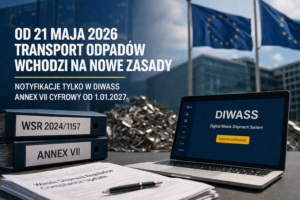


From 21 May 2026, the DIWASS Regulation will come into force, which will transform the European waste trade.
Just a few months ago, many business owners regarded DIWASS as „yet another EU IT project”, which will no doubt be postponed or implemented only in part. Today, there is no longer any doubt that the digitisation of cross-border waste shipments in the EU is just getting underway.
On 21 May 2026, new obligations arising from EU Regulation 2024/1157 will come into force. For the waste management sector, this represents one of the biggest administrative changes in years. And although some in the market have not yet realised this, in a few weeks’ time it may turn out that failure to register with the DIWASS system will prevent transport operations from taking place.
What is actually changing?
The DIWASS system is ultimately intended to fully digitise the European waste management sector. Every notification, authorisation, movement document and transport participant’s details are to be managed within a single, common system for the whole of the European Union.
From 21 May 2026:
- the DIWASS system is becoming mandatory for notification procedures,
- all parties involved in the shipment of waste must be registered,
- The new templates for Annex VII and for agreements on the transboundary movement of waste come into force.
Importantly, the system does not allow for the manual entry of company details. Every party involved in the process must be listed in the database of registered entities. This simply means that if a carrier, consignee or declarant is not registered with DIWASS, the document will simply not be generated.
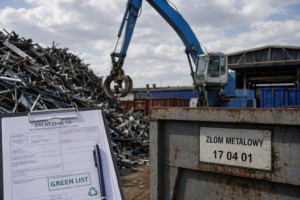
The European Commission has acknowledged that the integration of local systems is not yet complete. Consequently, a transitional period has been introduced for documents listed in Annex VII. In practice, this means that from 21 May to 31 December 2026, documents relating to waste on the so-called „green list” may continue to be issued primarily in paper form. For many companies trading in aluminium, copper Whether non-ferrous metal scrap is included is a huge relief. In my view, this relief is only partial. A belief has begun to take hold in the market that „since the green list remains in paper form, there is no need to set up a DIWASS account” – this is a very risky approach. For whilst the administration of Annex VII itself may be handled outside the system on a temporary basis, DIWASS is already becoming the central database for transport operators.
If a foreign partner, carrier or consignee decides to handle documentation digitally, the fact that a Polish company is not registered could bring the entire shipment to a standstill. Therefore, from a practical point of view, registration with DIWASS is now essential, even for companies operating exclusively on the green list.
The new regulations also cover the export of waste to third countries outside the EU. Furthermore, even if a recipient outside the EU does not use the DIWASS system, the obligations on the part of the European exporter remain in force. In practice, this means that a Polish company will often have to enter its foreign partner’s details into the system itself.
As regards the export of waste outside the EU, it should be borne in mind that, by 21 February 2025, non-OECD countries were required to submit applications to the European Commission to be allowed to continue importing waste from the EU.
The list includes, amongst others:

The European Commission is due to publish an official list of countries authorised to continue importing waste from the EU by 21 November 2026. This could be a turning point for the European recycling market. Because if some countries do not receive authorisation, some of the world’s export routes will simply disappear.
If we ask ourselves what companies in the waste management sector should be doing right now, I believe there are three key actions:
- Register your business with DIWASS Naweven if you are currently operating exclusively on the green list.
- Verify trading partners and carriers
If just one participant fails to register, it could bring the whole process to a standstill.
- Prepare new document templates. From 21 May, the new formsin Annex VII and the new contract templates will come into force.
Europe is just beginning the full digitalisation of the waste market, and I have no doubt that DIWASS is just the start of much bigger changes. The EU is clearly moving towards full control of the flow of secondary raw materials, curbing illegal exports and increasing oversight of recycling. And this means one thing: the waste industry is entering a new era of digital oversight. Companies that prepare well in advance will gain a competitive edge. The rest may very quickly find themselves facing administrative chaos and blocked transport operations.
RM 18 May 2026