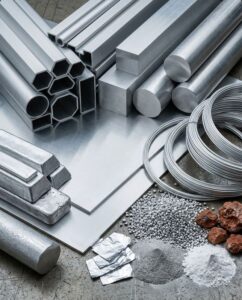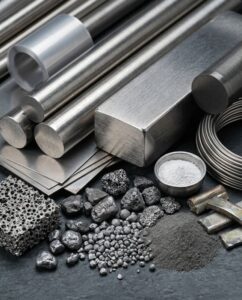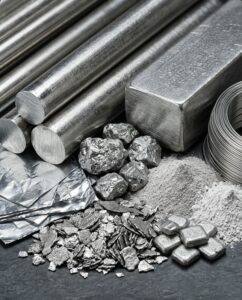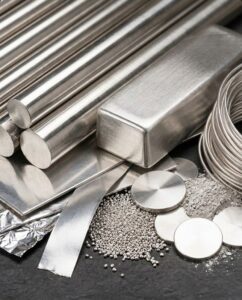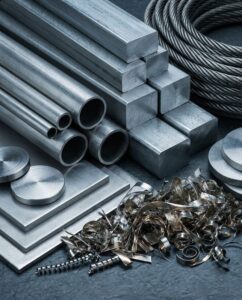


Aluminium is one of the most widely used metals, found in many everyday products, from beer cans to car and aeroplane parts.
Although aluminium is the second most commonly used metal after steel, it does not occur naturally in the environment, and its production is an energy-intensive and complex process.
The three stages of aluminium production
Around 390 million tonnes of bauxite ore are produced worldwide each year, of which 85% is used in the production of aluminium.
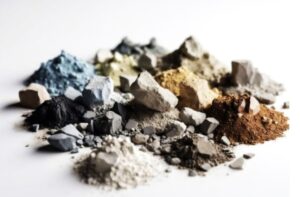
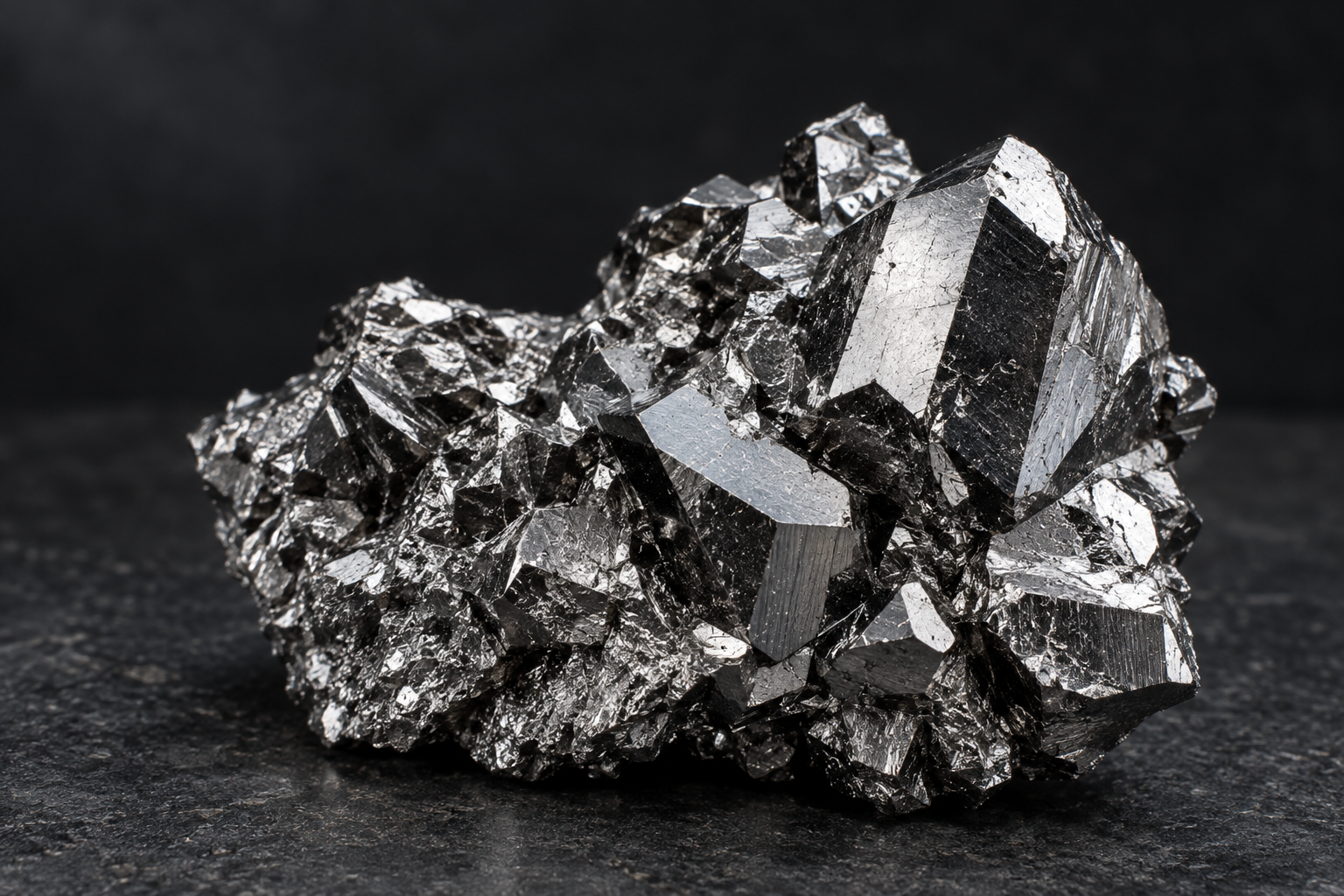
Bauxite is not a specific mineral, but a clayey sedimentary rock consisting mainly of hydrated aluminium oxides (hydrargillite, bemiite or diaspore), which form in tropical and subtropical climates. The minerals commonly associated with bauxite deposits are clay minerals, silica, and iron oxides and hydroxides. They form in the greatest quantities in areas where aluminosilicate rocks are weathered in hot climates; consequently, bauxite mining is most highly developed in Australia, Brazil, China, Central America, Africa, France and Greece. In Poland, bauxite deposits are found, amongst other places, near Nowa Ruda in Lower Silesia.
Once extracted, bauxite is refined into aluminium oxide, which is then converted into aluminium.
Aluminium is processed from bauxite ore into metal in three stages.

Stage 1: Bauxite mining
Bauxite is usually extracted from the ground in open-cast mines, with just three countries – Australia, China and Guinea – accounting for for 72% global bauxite production.
| Country | 2022 Bauxite production at the mine (tonnes) | % of the total |
|---|---|---|
| Australia | 110,000,000 | 28.2% |
| China | 86,000,000 | 22.1% |
| Guinea | 85,000,000 | 21.8% |
| Brazil | 32,000,000 | 8.2% |
| India | 22,000,000 | 5.6% |
| Indonesia | 18,000,000 | 4.6% |
| Russia | 6,200,000 | 1.6% |
| Jamaica | 5,800,000 | 1.5% |
| Kazakhstan | 5,200,000 | 1.3% |
| Saudi Arabia | 4,300,000 | 1.1% |
| The rest of the world | 15,500,000 | 4.0% |
| Total | 390,000,000 | 100.0% |
Australia is the world’s largest producer of bauxite and is also home to the world’s largest bauxite mine, known as Weipa.
Guinea, the world’s third-largest producer of bauxite, has over seven billion tonnes of bauxite reserves – more than any other country in the world. Furthermore, Guinea is the world’s largest exporter of bauxite. As many as 76% Guinea’s exports go to China.
Once the bauxite has been extracted from the ground, it is sent to a smelter to produce aluminium oxide, which is the second stage of the production process.
Stage 2: Production of aluminium oxide
In 1890, the Austrian chemist Carl Josef Bayer invented a revolutionary process for extracting aluminium oxide from bauxite. Today, more than 100 years later, approximately 90% The smelter still uses the Bayer process to refine bauxite.
The four key stages of the Bayer process:
- Mineralisation:
Bauxite is mixed with sodium hydroxide and heated under pressure. At this stage, the sodium hydroxide selectively dissolves the aluminium oxide from the bauxite, leaving other minerals behind as impurities. - Filtration:
Impurities are separated and filtered out of the solution, forming a residue known as red sludge. Once the sludge has been removed, the aluminium oxide is converted into sodium aluminate. - Precipitation:
The sodium aluminate solution is cooled and precipitated into a solid, crystallised form of aluminium hydroxide. - Calcination:
Aluminium hydroxide crystals are washed and heated in calciners to produce pure aluminium oxide – a sandy-white material.
The sludge produced during the aluminium oxide manufacturing process poses a serious environmental problem. For every tonne of aluminium oxide, smelters produce 1.2 tonnes of red sludge, which is stored, and it is not entirely clear what to do with it next. Currently, there is over three billion tonnes this material.
China is the world’s second-largest producer of aluminium and the largest importer of bauxite, supplying over half of the world’s aluminium oxide.
| Country | Aluminium oxide production in 2022 (tonnes) | % of the total |
|---|---|---|
| China | 74,000,000 | 53% |
| Australia | 21,000,000 | 15% |
| Brazil | 11,000,000 | 8% |
| India | 6,800,000 | 5% |
| Russia | 3,100,000 | 2% |
| Germany | 1,900,000 | 1% |
| Ireland | 1,900,000 | 1% |
| Saudi Arabia | 1,800,000 | 1% |
| Ukraine | 1,700,000 | 1% |
| Spain | 1,600,000 | 1% |
| The rest of the world | 15,100,000 | 11% |
| Total | 139,900,000 | 100% |
Aluminium oxide is used in many industries, including the manufacture of plastics, cosmetics and chemicals. Nevertheless, 85% Aluminium is produced from bauxite.
Stage 3: Aluminium production
Aluminium oxide is converted into aluminium by electrolytic reduction. In addition to aluminium oxide itself, the following is required for the production of aluminium: cryolite and a huge amount of electricity.
Cryolite is mainly used as a flux to lower the temperature in the electrolytic production process aluminium. Due to high demand and its scarcity, a synthetic compound is currently used.
Below is a simplified description of the aluminium production process:
- In aluminium smelters, hundreds of electrolytic cells, together with their reduction cells, are filled with molten cryolite.
- Aluminium oxide (consisting of two aluminium atoms and three oxygen atoms) is then poured into these tanks, where a strong electric current breaks the chemical bond between the aluminium and oxygen atoms.
- As a result of electrolysis, pure liquid aluminium settles at the bottom of the cell; it is then purified and cast into various shapes and sizes.
China is the largest producer of aluminium and is also its largest consumer. India, which borders China, is the second-largest producer, accounting for just one-tenth of China’s output.
| Country | 2021 Aluminium smelter production (tonnes) | % of the total |
|---|---|---|
| China | 39,000,000 | 59% |
| India | 3,900,000 | 6% |
| Russia | 3,700,000 | 6% |
| Canada | 3,100,000 | 5% |
| United Arab Emirates | 2,600,000 | 4% |
| Australia | 1,600,000 | 2% |
| Bahrain | 1,500,000 | 2% |
| Iceland | 880 | 1% |
| The United States | 880 | 1% |
| The rest of the world | 9,400,000 | 14% |
| Total | 66,560,000 | 100% |
As with the production of aluminium oxide, some countries that produce bauxite and aluminium oxide also produce aluminium. These include India, Australia and Russia.
In 2022, the global aluminium market was valued at approximately 245.7 billion dollars, it is forecast that by 2030 the aluminium market will almost double in size to USD 498.5 billion.