

The waste market, particularly in the metals sector, has for years operated on the basis of experience, relationships and operational practice. Documentation was, of course, mandatory, but the way it was circulated and compiled often depended on the specific situation, rather than always following a structured process. With the introduction of the DIWASS system, this era is coming to an end.
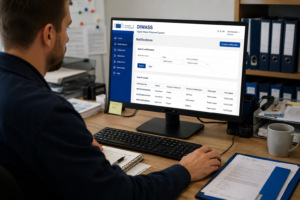
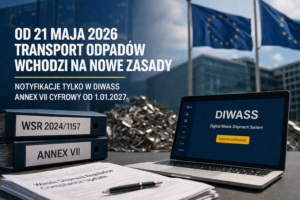
From 21 May 2026, the use of the digital system for handling cross-border waste transport will become mandatory. This system, based on Regulation (EC) No 1013/2006, introduces the full digitisation of documents, in particular Annex VII for the so-called ‘green list’ of waste. This means that every shipment will have to be registered in the system, and all parties involved in the operation – the producer, the carrier and the consignee – will be required to digitally approve it.
It could be argued that DIWASS is not merely another administrative tool, but a genuine change in the way the market operates. Until now, it was possible to operate under a model in which some processes were „finalised” operationally – documents were completed during transport, signatures were sent later, and responsibility was allocated informally. The new system eliminates this possibility. In practice, failure to register in advance or obtain approval from any of the parties means that the transport cannot legally take place.
On the one hand, this means greater control and formalisation. On the other hand, it brings order to the market. The introduction of a requirement to register every consignment in advance (at least two days before dispatch) and the need to clearly assign responsibility to specific parties reduces the risk of errors, misunderstandings and disputes. Although the transparency of the process places organisational demands on companies, in the long term it stabilises cooperation between partners.

The introduction of DIWASS will have a direct impact on the import and export of waste within the European Union. Processes will become longer and more rigid. Each shipment will have to be planned in advance, which will limit the ability to respond to short-notice commercial opportunities. At the same time, transaction security will increase – transparency and full traceability of operations will reduce the number of disputes and ambiguities regarding quality and formalities.
However, the consequences will be far more significant when it comes to trade with non-OECD countries. Even now, the export of waste to non-OECD countries is subject to very strict restrictions and, in many cases, is completely prohibited. DIWASS will further tighten the rules in this area.
In practice, this means that any attempt to export waste outside the OECD will be subject to even greater scrutiny, and the documentation trail will become fully transparent to the authorities. There will no longer be scope for an „interpretative” approach to waste classification or the destination of shipments. The system will require the unambiguous assignment of codes, consignees and countries of destination, which will significantly limit the scope for carrying out such operations.
In the case of waste imports from outside the OECD, the situation will be similar. Each consignment will have to be registered and approved in advance, and responsibility for ensuring the documentation is in order will rest with all parties in the supply chain. This means greater operational risk when working with partners outside the EU, who often operate within less formalised systems.
Consequently, it can be expected that:
- the export of waste outside the OECD will, in practice, be restricted even further,
- imports from these countries will become more difficult and more formalised,
- some of the material flows will be redirected to EU or OECD countries,
- The importance of stable, reliable partners will increase.
The biggest challenge, however, is not the system itself, but preparing for its implementation. In practice, this means registering all participants in the process, training staff and adapting the organisation to work under the new model. Companies that treat DIWASS as a mere formality may very quickly encounter operational problems – suspended shipments, delays or the risk of penalties. Conversely, organisations that adopt a systematic approach to the matter will gain an advantage in terms of predictability and greater control over the process.
From RMC’s perspective, the implementation of DIWASS represents a natural direction for market development. Already today, it is not only prices and access to raw materials that are of key importance, but also the quality of operations, the repeatability of processes and the ability to meet regulatory requirements in a safe and predictable manner. The digitisation of documentation is part of this trend.
To sum up, DIWASS does not change the waste market itself, but it does change the way it operates. It reduces improvisation and forces processes to be organised. For some, this will be a barrier; for others, a tool for building a competitive advantage. In the long term, those who treat their operations as a stable, long-term business will benefit from this.
RM 29 March 2026