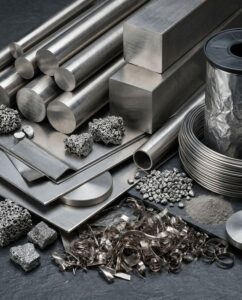


It has now been several months since my last analysis of the aluminium market. This naturally raises the question: has anything changed, what is currently happening in the market, and what are the forecasts for the near future? Is it worth it today invest in aluminium and wait for prices to rise, or play it safe? What about scrap metal prices, casting alloys, wheel rims, as well as so-called ‘premium aluminium’ – such as profiles, food-grade aluminium or other homogeneous alloys? The final investment decisions are up to you, but below I set out my current observations and forecasts.
The Premium Aluminium Market
When analysing the premium aluminium market, one should look beyond the prices charged by European foundries. The following factors are of key importance here:
- price of primary aluminium (primary aluminium),
- the cost of producing it,
- and, in the longer term, being implemented the CBAM system, i.e. carbon footprint levies on aluminium imported from outside the EU.
In my view, over the next 2–3 months there is a real the risk of a fall in premium aluminium prices. At present, the premiums offered by foundries for premium scrap exceed by approx. 70 EUR/t the price of the original goose. It is worth asking the question: Why do foundries pay more for scrap than for pure aluminium with a guaranteed chemical composition and certificates? Answer: They are trying to reduce CO₂ emissions and adapt their products to the requirements of the „green industry”. However, financial pressure may soon put these ambitions to the test – if profit margins fall below the levels expected by the owners.
Furthermore, the demand situation is unstable – many sectors, particularly the construction industry, are in crisis. This has a direct impact on demand for aluminium profiles, sheets and other aluminium-based products.
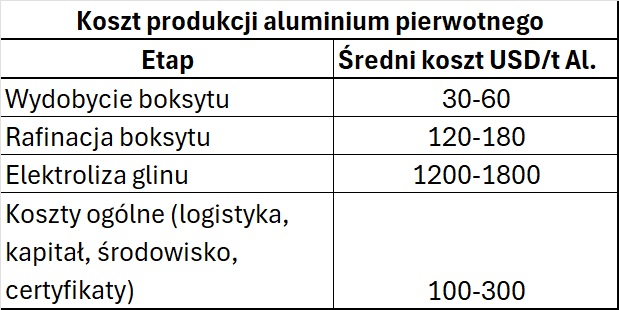
As for what might be possible a fall in the price of primary aluminium on the LME – there is still scope for reductions. Depending on the energy source and the region of production, The cost of producing 1 tonne of aluminium ranges from US$1,450 to US$2,300. By way of comparison, the price of crude oil in Rotterdam, including premiums and customs duties, currently exceeds 2,800 EUR/t.
Analysis of the aluminium market
Taking into account:
- holiday-related restrictions on the supply of scrap metal,
- reduced foundry activity,
- and the general economic slowdown,
I expect that prices for premium scrap during the summer holiday period will be linked to LME HG quotations. After the holiday season, foundries are likely to start reducing premiums in order to narrow the gap between scrap and primary aluminium.
The Aluminium Market for the Production of Casting Alloys
The foundry alloys market The market is currently characterised by relative price stability for goose meat, though there is a marked lack of demand. Key producers in Poland have unused production capacity and are struggling with a limited number of orders. This market is heavily dependent on the automotive sector, the state of which – particularly with regard to internal combustion engine vehicles – can hardly be described as good.
At the same time, it is worth taking a closer look at prices of alloying elements, in particular silicon, which is a key component of foundry alloys. In 2025 its prices have fallen by between a few and a dozen or so per cent, depending on the source.
In addition to commodity prices, the following factors also have an impact on the situation:
- energy and gas costs,
- the supply of scrap metal,
- and the overall state of European industry.
The summer season is traditionally associated with a slowdown in production, holiday breaks and weaker demand. For this reason, we believe that prices for wheel rims, plastics and casting alloys will gradually fall over the summer holidays. The extent of these changes will depend mainly on the availability of scrap metal.
How Can You Make Money from Aluminium When Prices Are Falling?
In the event of an expected fall in prices, a cautious approach seems the most sensible. I suggest:
- build a safe margin,
- avoid speculation,
- sell the material on an ongoing basis, even in smaller batches,
rather than hoarding it in the hope of price rises that may never materialise.
It is better to operate whilst maintaining liquidity and flexibility than to risk incurring losses resulting from a sudden market crash.
To sum up
The aluminium market It faces many challenges today – ranging from regulatory changes (CBAM) and environmental pressures to an economic slowdown and a crisis in sectors that are key to demand. In the short term, I do not foresee any sharp price rises. Rather, I expect prices to stabilise or fall, both in the premium aluminium market and in the foundry alloys market. I would expect significant changes more likely towards the end of Q2 2026, following the introduction of CBAM levies (60–80 euros per tonne).
As well as substantive analyses, we must bear in mind politics, tariffs and wars. These can turn everything on its head.
14 July 2025 – RM